EIGHT CENTURIES OF HISTORY
History of the Castle
“You who are about to cross the drawbridge of this castle, know that you are stepping into history.”
"Montcornet, a true feudal coliseum."
Jules Michelet, 1839
Historical Overview
Montcornet takes its name from the rocky spur — the Mont Cornu (“Horned Hill”) — on which the fortress was built. During the 11th and 12th centuries, the Montcornet family constructed the first castle on the site. In the 13th century, it became the property of the Noyers family, Burgundian lords. In the 15th century, it passed to the powerful House of Croÿ, which would keep it for nearly two centuries. During this period, the fortress underwent extensive restoration and became the “feudal coliseum” so admired by historian Jules Michelet. From the 17th to the 19th century, it successively belonged to Charles de Gonzague (founder of Charleville), the Duke of Mazarin, and later the Duke of Aiguillon-Richelieu, who ordered its dismantling in 1766. In the 19th century, it passed by inheritance to the Counts and Marquises of Chabrillan. In 1961, Abbé Bernard Lussigny (1921–2009) acquired the castle and gave Montcornet a new life.
The Origins
Montcornet Castle is one of the most important surviving medieval fortifications in the Ardennes. This true “feudal coliseum,” as Michelet described it, was listed as a Historic Monument in 1926.
Located in the Porcien region and perched on the edge of the Ardennes plateau, the Mont-Cornu (Mons Cornutus), a naturally fortified rocky spur, was destined to host a defensive stronghold. Its commanding position made it ideal for observing both military and peaceful movements throughout the surrounding countryside.
The Legend of the Origins
The site may have been occupied as early as the Neolithic period, as evidenced by several prehistoric hand axes discovered there. The transformation of the spur into an oppidum likely dates back to the Gallic era. Around the year 500, during the reign of Clovis, these lands were administered by Saint Remi, Bishop of Reims.
Later, King Lothair, who reserved the Ardennes Forest as his hunting ground, had a castle built here to serve as a refuge and hunting lodge. Charles, Louis the Pious, and their successors, all passionate hunters, would travel from Attigny along the King’s Road and rest at Montcornet, one of their favorite residences.
The House of Montcornet
At the end of the 10th century, a family of ministeriales known as the Montcornets undertook the development of the surrounding lands. The first of them, Hugues I, entered the ranks of the nobility through his marriage to Béatrice de Reynel and rose among the kingdom’s most influential lords. His descendant Jeanne II, heiress to half of the Porcien region, married Miles de Noyers, Royal Cup-Bearer and Marshal of France.
The Hundred Years' War
During the Hundred Years’ War, members of the Noyers family were captured several times by the English and forced to pay heavy ransoms that ruined their lordship.
The population, devastated by plague, struggled to survive. Charles de Noyers-Mello eventually sold Montcornet to Antoine de Croÿ, who purchased it in 1446.
The Splendour of the Croÿ Era
A golden age began under Antoine I de Croÿ, Knight of the Order of the Golden Fleece and Grand Chamberlain to Philip the Good, Duke of Burgundy. The castle was transformed into the imposing fortress visitors see today. Montcornet became one of the major political and cultural centres of the Ardennes, supported by eleven fortified manors. Philippe II de Croÿ served as Chamberlain to King Francis I — who stayed at the castle around 1514 — and as Governor of Hainaut.
The Wars of Religion
In 1561, Antoine II de Croÿ converted to Calvinism and expelled priests and religious orders from his lands. As a leader of the Calvinist movement, he founded three villages in 1566 — Bourg-Fidèle, Charlebourg, and Arches-Bruyère — to welcome followers driven from France and the Holy Roman Empire. Catholics eventually took revenge by blowing up the Square Tower, which had been packed with munitions. Its remains can still be seen on the eastern side of the castle.
The Dismantling
The barony was awarded in 1613 to Charles de Gonzague, Duke of Nevers and founder of Charleville, who elevated it to the rank of marquisate. Later inherited by the Duke of Aiguillon, minister to Louis XVI, the castle was dismantled around 1760, which explains the ruined state in which it survives today.
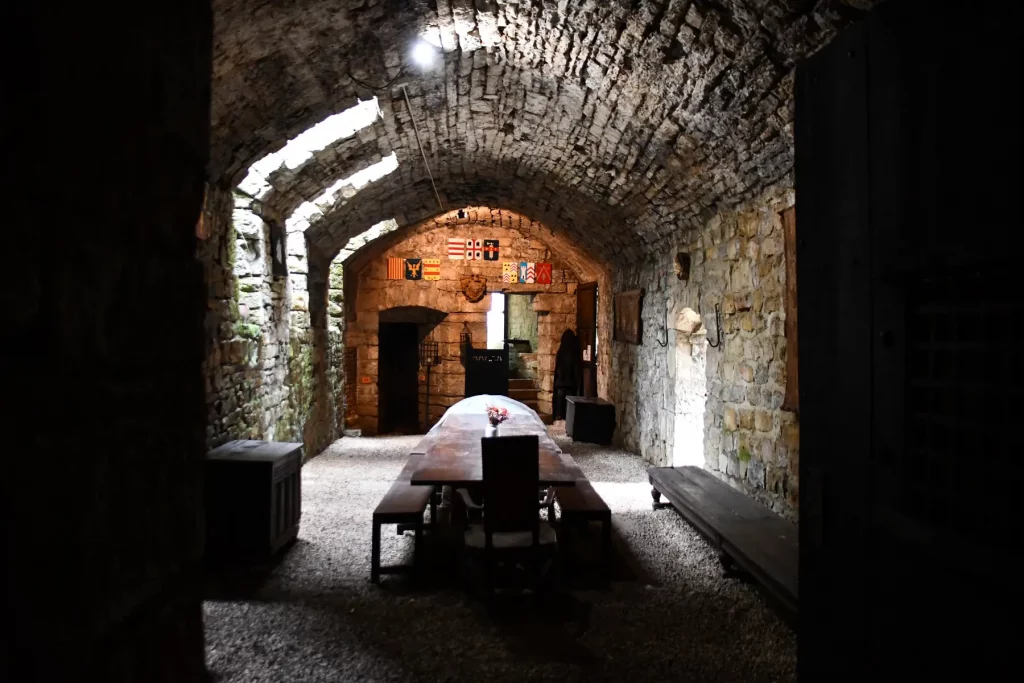
The Great Hall, a vast stone vessel once again open to visitors.
Remarkable Architecture
The castle reflects the immense transformation carried out by the Croÿ family in response to a revolutionary new weapon: artillery and gunpowder. The walls were reinforced to withstand iron cannonballs, and gunports were added throughout the fortifications. At ground level, some walls exceed five metres in thickness.
The Outer Bailey & Barbican
An 8-metre-diameter keep tower, equipped with an 11-metre-deep cistern and an ice cellar, offers magnificent views over the valley. To the east stands a remarkable oval artillery tower with projecting “ears” (orillons), housing two powder magazines. During the 16th century, a traditional drawbridge and a barbican were added, creating an advanced defensive structure designed as a deadly trap for attackers.
The Legend of Odette and Salvien
As recounted by André Dhôtel in Distant Ardennes.
"Farewell, Odette! May 5, 1795. Salvien."
Salvien and Odette had loved each other since childhood and were promised to one another. However, a wealthy farmer’s son, Pierre Terreau, asked for Odette’s hand in marriage, and her parents forced her to accept. To meet in secret, Salvien would enter the castle and stand beneath the low window of the Round Hall, where Odette would come and speak with him through the bars. Consumed by jealousy, Terreau followed Salvien one day and locked the massive bolt behind him — a lock no man could break.
Salvien was never seen alive again. On the day of his wedding, Terreau cruelly brought Odette to the castle. There she saw her beloved, dead but still leaning against the window where he had waited for her. She died shortly afterward. As for Terreau, while wandering near the ruins, he saw two fiery eyes staring from a gaunt face in the darkness. The next morning, his lifeless body was found at the foot of an embankment.
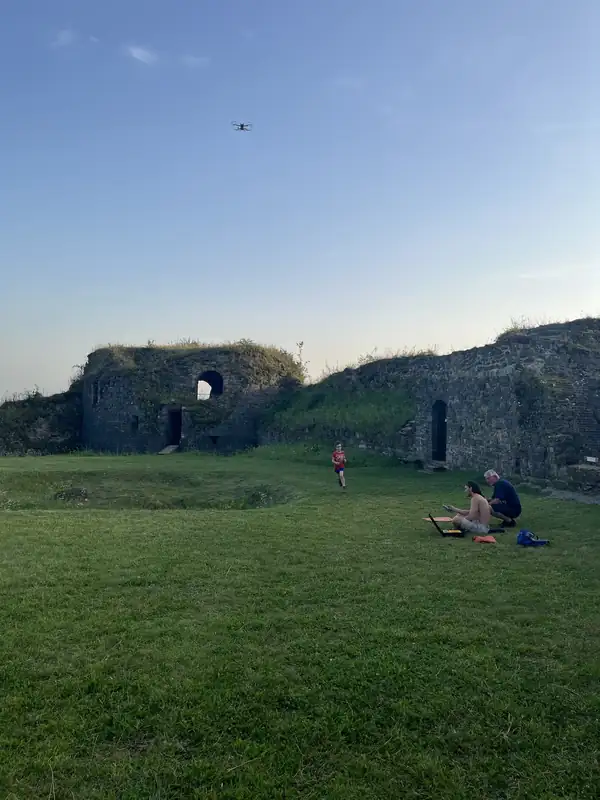
The courtyard and ramparts, once again open to visitors.
A New Beginning
Inspired by the wild beauty and grandeur of the site, our association works tirelessly to bring this “fortress on the borders of the kingdom” back to life. Nature had reclaimed the ruins: brambles and ivy covered the towers. The clearing and consolidation work carried out with limited resources was immense. The halls and underground passages were emptied and restored, lighting was installed, and the objects discovered on site were displayed in the exhibition room. At last, the castle could be opened to the public once more.
To learn more, a booklet on the history of the castle is available at the entrance for €2.